IEC 61850 vs. IEC 60870-5-104: What is the difference?
IEC 61850 and IEC 60870-5-104 are two key protocols in energy automation – but for different jobs. We explain the differences, how they work together and when migration makes sense.
In this article
IEC 61850 and IEC 60870-5-104 turn up in almost every substation – and are still frequently confused. Both are standardised communication protocols used in power systems, but they solve different tasks and operate at different levels. Knowing their roles helps you make the right call for new builds, modernisation and control-centre connectivity.
IEC 60870-5-104 – the telecontrol protocol
IEC 60870-5-104 ("104" for short) is the network variant of the IEC 60870-5-101 telecontrol standard: it transmits telecontrol data over TCP/IP. Traditionally, 104 connects a higher-level control centre (SCADA) with substations or RTUs, working on a master/slave basis (controlling station ↔ controlled station).
- Purpose: vertical telecontrol communication between control centre and substation/RTU
- Transport: TCP/IP (port 2404), lean and robust
- Data: measured values, single- and double-point information, counters and commands
- Addressing: flat information object addresses (IOA), coordinated manually between the stations
- No self-describing data model: the meaning of a data point lives in the engineering, not in the protocol
IEC 61850 – the standard for substation automation
IEC 61850 is far more comprehensive: an international standard for communication and interoperability in substations and smart grids. Rather than mere data transfer, it defines an object-oriented, self-describing data model and end-to-end engineering.
- Purpose: communication within the station (horizontal, between IEDs) and towards the control system
- Data model: object-oriented and self-describing via logical nodes
- Services: MMS for client/server, GOOSE for fast event messaging and Sampled Values (SV) for measured values
- Engineering: end-to-end via SCL files (ICD, SCD)
- Interoperability: vendor-independent – devices from different manufacturers understand each other
For a detailed introduction, see the article What is IEC 61850?.
The key differences at a glance
Both protocols now run over Ethernet and TCP/IP, but they pursue different goals:
- Level of use: 104 connects control centre and station (vertical); IEC 61850 additionally organises communication inside the station (horizontal, between IEDs).
- Data model: 104 uses flat object addresses without semantics; IEC 61850 provides a self-describing, object-oriented model.
- Engineering: with 104, addresses are coordinated manually between sender and receiver; IEC 61850 describes the entire installation end-to-end via SCL.
- Real time: 104 covers classic telecontrol latencies; IEC 61850 offers real-time-capable protection communication with GOOSE and Sampled Values.
- Scope: 104 is a lean transmission protocol; IEC 61850 is a comprehensive standard for data model, services and engineering.
Competitors or complements?
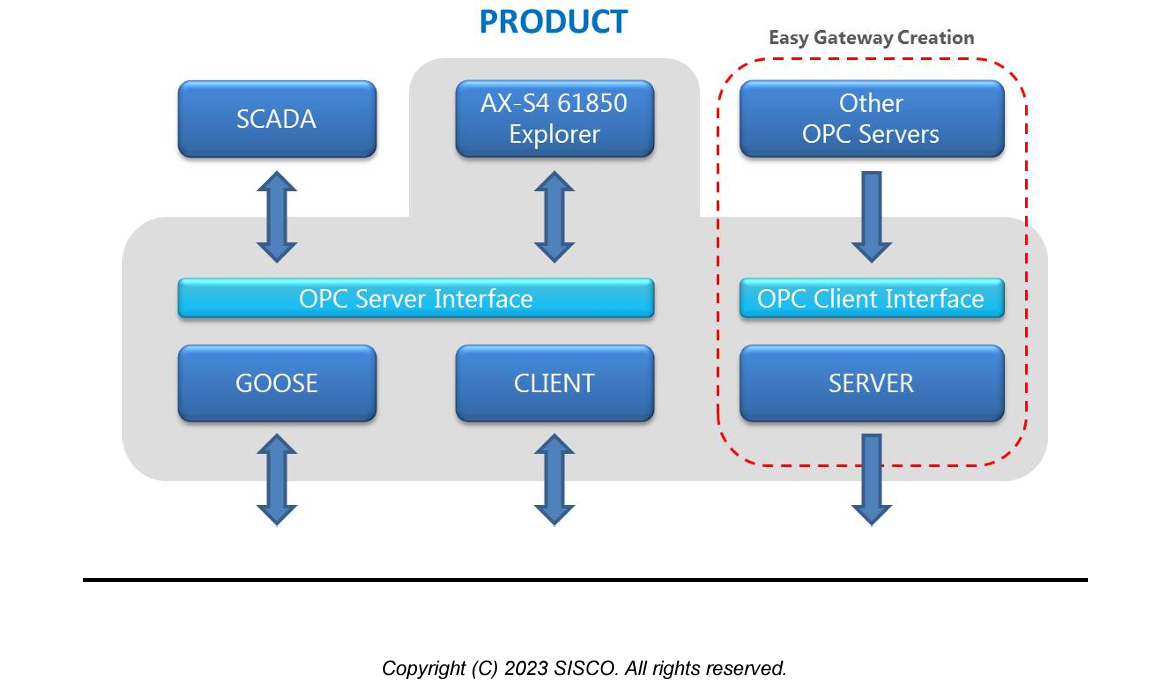
In practice, the two are usually not competitors but complement each other. A typical picture: IEC 61850 organises communication inside the digital station, while IEC 60870-5-104 handles the telecontrol link to the higher-level control centre. Protocol converters (gateways) map the IEC 61850 data onto 104.
It is similar when coupling control centres with one another: there, ICCP / TASE.2 (IEC 60870-6) is often used. So for an end-to-end system the protocols should not be chosen against each other, but correctly combined.
When is migrating to IEC 61850 worth it?
Moving to – or expanding towards – IEC 61850 pays off above all when:
- a station is newly built or comprehensively modernised (digital substation),
- devices from many manufacturers need to work together interoperably,
- end-to-end, tool-supported engineering is wanted instead of manual address lists,
- fast protection communication (GOOSE) or digital measured-value transmission (Sampled Values) is required.
For simply connecting an existing RTU to a SCADA control centre, however, IEC 60870-5-104 often remains the leaner, proven choice. The answer is frequently not "either/or", but: the right protocol per interface – joined by gateways.
IEC 62351: security for IEC 61850 and IEC 60870-5-104
Because both IEC 61850 and IEC 60870-5-104 communicate over standard Ethernet and TCP/IP, cybersecurity is gaining importance. The IEC 62351 series complements both with security mechanisms such as authentication and encryption (e.g. TLS) – essential for protecting critical infrastructure.
IEC 61850 and IEC 60870 in practice – how IESOFT supports you
As a specialist in communication protocols for the energy sector, we support you with IEC 61850, IEC 60870 and ICCP/TASE.2 – from consulting, development and training through suitable products to certifying your devices. Get in touch.
Published on: